
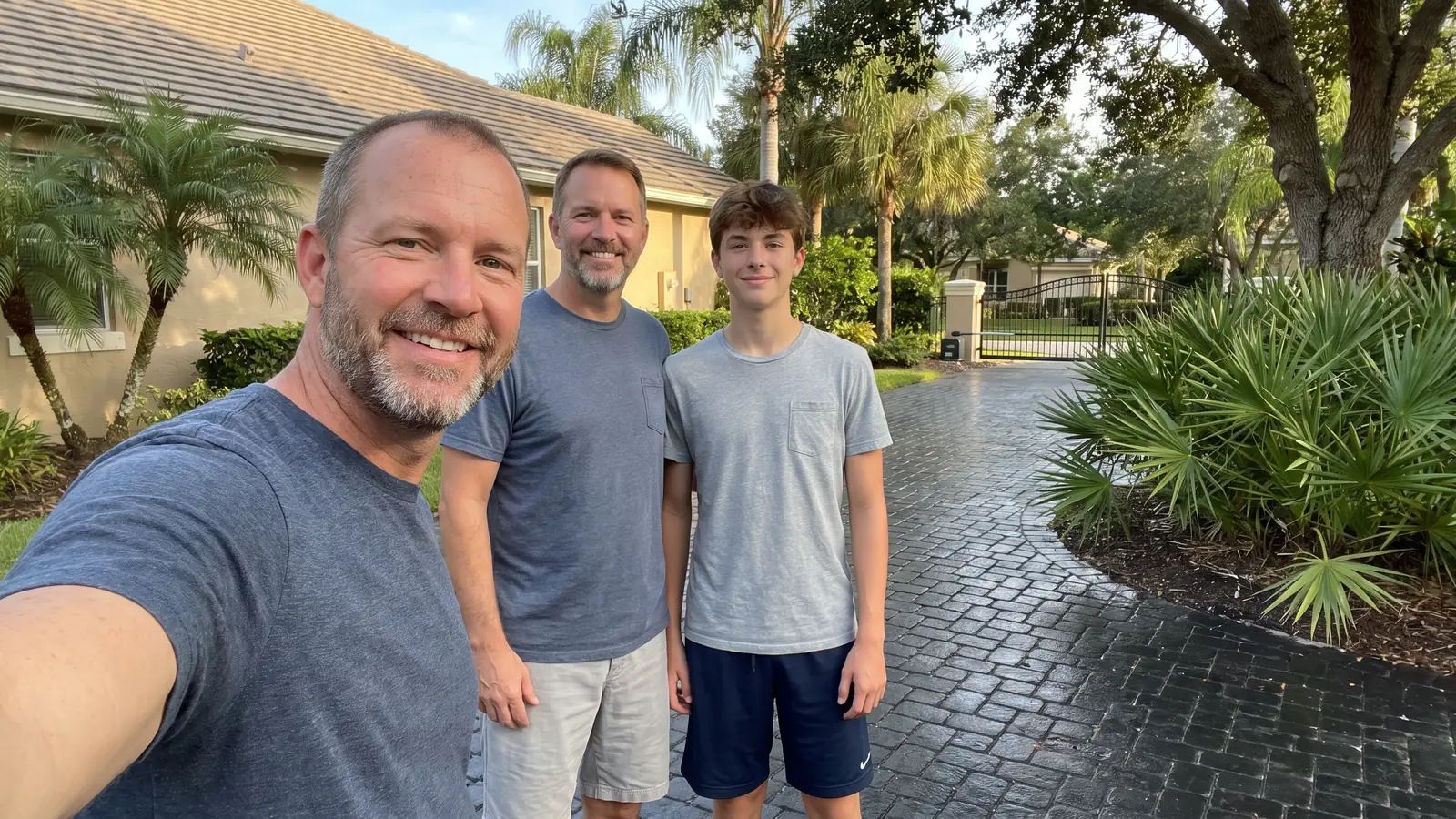
Paver sealing for Jacksonville Beach homes
Paver Sealing in Jacksonville Beach, FL
Pale pavers show salt marks fast near the pier, so call (904) 966-4279 for a free Jacksonville Beach estimate.
- Brings out deeper paver color
- Fresh joint sand helps lock pavers in place
- Gives weeds less room to grow
- Makes the surface easier to keep clean
- Free estimate, no obligation
Request a Free Estimate
Free, no obligation.
Fast, careful paver sealing in Jacksonville Beach
Paver sealing in Jacksonville Beach is a free estimate away, whether the pavers sit near A1A or on a side street west of Third Street. A local contractor cleans them, packs fresh joint sand and rolls on a coat. Ask for a quote and you will hear back within 1 business day, usually much sooner. You can book your free estimate in about a minute.
Think of the driveway that used to be a warm tan and now looks washed out, with a white crust along the edge where sea mist dries. A wash and a new coat bring the color back and keep the salt from settling in. If you would rather talk it through, call (904) 966-4279 and say what you see. Nothing is owed if you decide to wait.
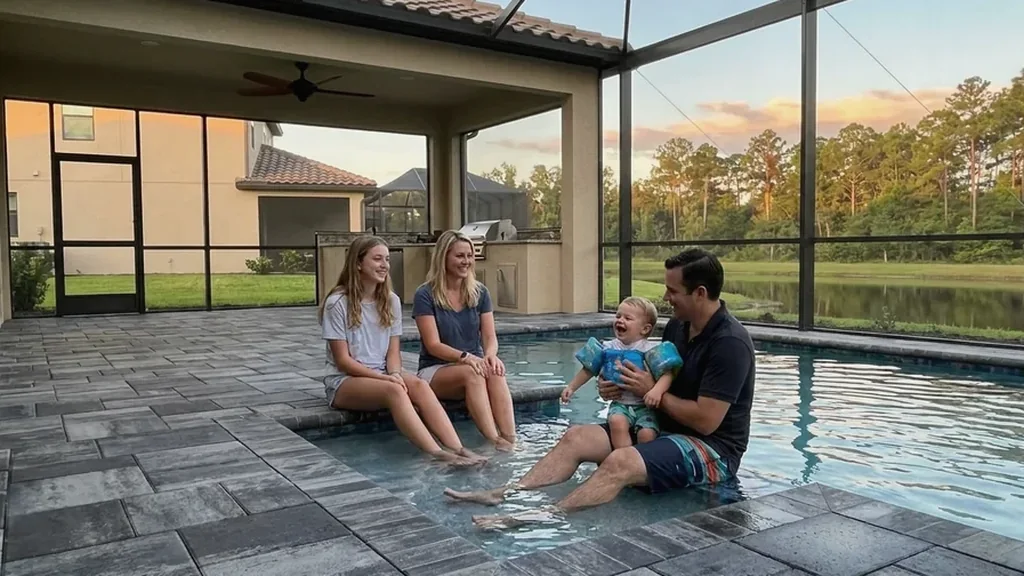
Why hire a local paver sealing contractor in Jacksonville Beach?
Jacksonville Beach sits on a barrier island with salt in the air and sea breeze showers most summer afternoons, so people here lean on a contractor who has seen coastal pavers up close. To hear how that fits your block, book your free estimate.
Free look at your pavers
A local contractor reviews your driveway, patio or pool deck and quotes a price in writing before you commit to anything.
A published range to compare
Local companies list $1.75 to $3.25 per square foot to clean, sand and seal. Hold any Jacksonville Beach quote up against it.
Pick the finish you like
A penetrating coat keeps the look natural. A film coat in matte or wet look adds depth. You choose, with prices side by side.
No pressure after the quote
You decide whether to book, and when. Asking for an estimate in Jacksonville Beach does not obligate you to a thing.
Get Your Free Estimate in Jacksonville Beach
Tell us about your pavers in Jacksonville Beach.
Free, no obligation
What paver problems show up most in Jacksonville Beach?
Salt crust on pale pavers
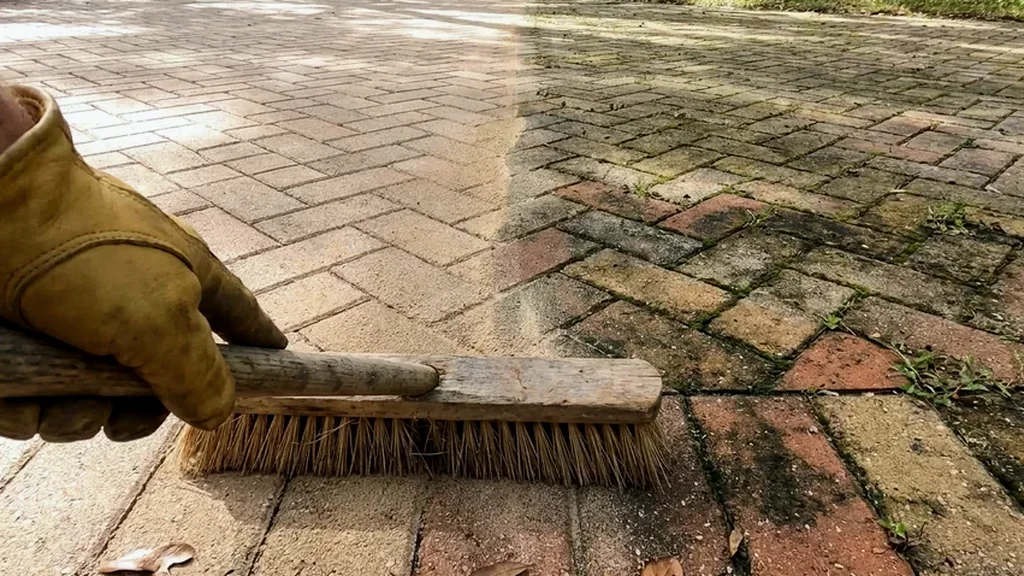
A paver maker writes that salt travels through the air as tiny particles and crystallizes on surfaces as moisture dries. It adds that pale pavers show splash marks, salt residue and sand sooner than darker ones. On Jacksonville Beach blocks near the ocean that can mean a chalky edge along a driveway. Routine rinsing helps, and sealer slows the build-up. Sealing also closes the surface a little, so spray and spills have less to soak into. Rinsing a patio now and then keeps the build-up from setting, and a sealed surface gives each rinse less to fight.
Sea breeze showers every summer afternoon
Jacksonville Beach averages about 52 inches of rain a year on roughly 122 rainy days, with August the wettest month at 7.54 inches. A nearly daily sea breeze can trigger showers in summer. Frequent soaking pushes sand out of joints and keeps shaded pavers damp. That damp film is where green and black growth starts. When joint sand washes out, pavers lose the lock that holds them level. Weeds and ants move into open joints. The wet season from June through September is more than half the yearly rain total for Northeast Florida. June averages 6.79 inches and September 7.19, so the wet months stack up from summer into early fall.
Flood water over the dunes
During Hurricane Matthew in October 2016, water went over the dunes and inland to at least 2nd Street, and News4JAX reported heavy flooding along the coast. Pavers that sit under salt water can end up with silt and a dull film. A film like that has to be washed off first, because sealer would lock it in place. After any flood, ask the contractor to check for settling, since sunken sections are repaired before sealing. The city lists its elevation at 0 feet and more than 66 percent of its area as water, so high water can reach a long way inland.
Drives and walks near the sidewalk
The city says many homeowners use public right-of-way beside their homes, and most of that use needs a revocable encroachment permit. Paver aprons by the curb take tire marks, mower oil and street dust all year. Check the rules for your own apron, then have the contractor clean and seal it with the rest. Oil, rust and tire marks are pretreated before sealing, and one Jacksonville company says some deep stains will not come out completely. The city's urban trail FAQ says paver driveway aprons are removed for trail work and replaced after the concrete trail is finished, so ask before you spend on an apron the city may touch.
Faded color on older beach homes
San Pablo Terrace homes were built from 1955 to 2005, and the city has a notable group of mid-century houses. Decades of beach sun can leave a driveway pale and uneven. A new coat evens the tone and slows the next round of fading, which keeps older homes looking cared for. Houses with clean mid-century lines tend to show an uneven driveway more, so one steady shade matters. About 98 percent of the homes in San Pablo Terrace are single-family, so many owners are caring for their own driveways. In a flood-zone review of Jacksonville Beach listings, Beach Homesites, Ocean Forest and Pine Grove sampled entirely outside the FEMA flood area, while Seascape Condo sampled fully inside, so conditions change block by block.
Which Jacksonville Beach neighborhoods can get paver sealing?
Where in Jacksonville Beach can pavers be sealed?
Paver sealing is available across Jacksonville Beach, from South Pablo Beach and Sea Grove to San Pablo Terrace and Ocean Terrace. Sea Grove has 174 homes built in the 1920s, and South Pablo Beach has a walkable grid close to the ocean. Short blocks mean short driveways, so ask the contractor to price each surface on its own line when you book your free estimate. Both areas sit close enough to the ocean that salt reaches the pavers.
What about San Pablo Terrace and Ocean Terrace?
San Pablo Terrace is a single-family community off Penman Road, with homes built from 1955 to 2005 and a median living area near 1,646 square feet. Ocean Terrace dates to the early 1980s and has a confirmed HOA near South Beach Park. That mix means a wide spread of driveway sizes, and a call to (904) 966-4279 gets each one priced. Pengate Forest nearby has 15 homes built from 1994 to 2023, and a new installation waits 30 to 60 days before its first coat.
Who decides at a condo or townhome?
Condos and townhome communities are part of the beach too. A Jacksonville paver page says shared patios, courtyards and walkways are usually managed by the association, so the board decides who sealer goes on. Small patios can also run into a company's minimum job size, so you can book your free estimate and ask how that works for a small space. Ask the board about sealer color, since a color-enhancing finish is more likely to need approval than a natural one.
What does paver sealing cost in Jacksonville Beach?
How is a beach lot priced?
Across Northeast Florida the published range for cleaning, sanding and sealing is $1.75 to $3.25 per square foot. For a beach lot, the number you see depends on the size, how dirty the pavers are and whether salt film or old sealer needs extra work. One company says it spends two to three hours of prep for every hour of sealing, which is why prep drives most quotes. Ask the contractor to book your free estimate and show each line.
What raises the cost of a reseal?
A failed old coat has to be stripped before new sealer goes on, and that raises the cost above a plain reseal. Lifted or sunken sections are fixed first, because sealing preserves the problem. Colored joint sand is another add-on, and one Jacksonville company lists six colors. Call (904) 966-4279 and ask which of these your quote includes.
| Paved area | Typical example | Clean, sand and seal |
|---|---|---|
| 300 sq ft | Small patio or walkway | $525 to $975 |
| 600 sq ft | Two car driveway | $1,050 to $1,950 |
| 1,000 sq ft | Large driveway or pool deck | $1,750 to $3,250 |
| 1,500 sq ft | Driveway plus pool deck | $2,625 to $4,875 |
Math based on the $1.75 to $3.25 per square foot that Northeast Florida paver companies published as of November 2026. Your contractor sets the actual price after seeing the surface. Repairs, leveling and stripping failed sealer are usually extra.
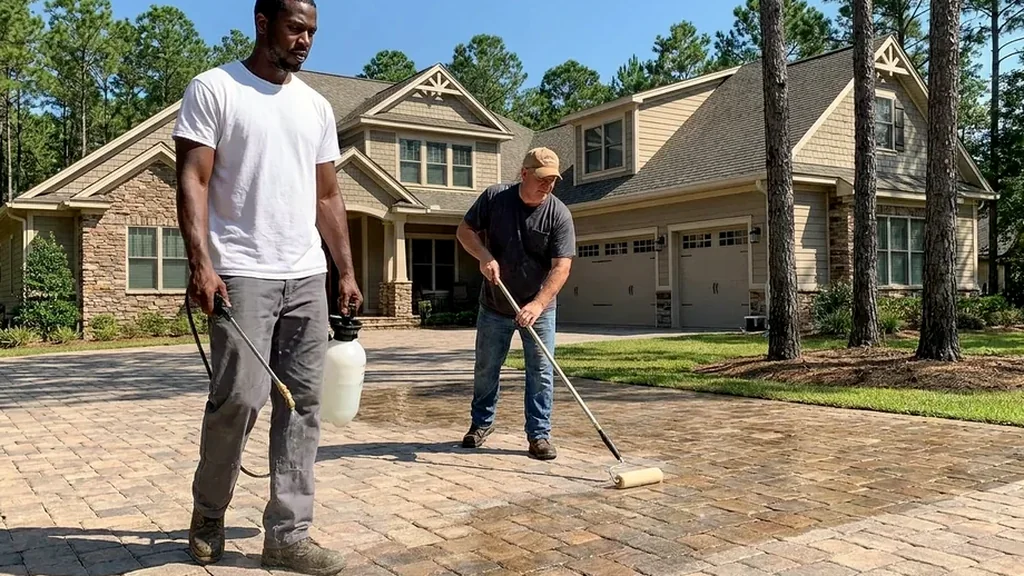
How does a paver sealing job work in Jacksonville Beach?
Check for salt, silt and sunken spots
The contractor walks the surface and notes any chalky salt crust, silt left by flooding, oil from the garage and low spots. Old sealer gets tested too. You see the notes before a price is set. You get the notes in plain words, with a price for each surface. A short written summary follows, with notes you can set beside other quotes.
Wash and rinse
A rotary cleaner lifts dirt, algae and salt film. Rinse water carries away what it lifts, which on a barrier island means a careful last pass near the street. Washing also removes joint sand, so that gets replaced. Planters, furniture and pool gear are moved first so the wash reaches the whole surface. Fixtures and furniture are moved so the wash reaches under tables and around planters.
Dry out
Pavers need to be dry before any coat. One Jacksonville page says that usually takes 24 to 48 hours after cleaning. Sea breeze showers in summer can stretch that, so the job waits for a dry window. A surface can look dry before the joints are, so the joints get checked too. A hand check of the joints makes sure the sand is packed and level.
Sand and seal
Fresh joint sand goes in and is packed down. Then the sealer is sprayed and back-rolled so it works into the joints. Thin even coats avoid the milky look that damp pavers or heavy coats can cause. On a pool deck, the contractor picks a product that keeps traction when wet.
Cure and check
Foot traffic is usually fine in a few hours, and cars stay off for about a day. Water that beads on the surface later tells you the coat is working. Once it soaks in, the coat is wearing out. Sealer needs about 24 hours of dry weather to cure, so sprinklers aimed at the pavers stay off. Salt builds back up near the ocean, so ask when a later rinse makes sense.
Complete paver services in Jacksonville Beach
How does a beach paver job start?
A beach paver job starts with a close look at salt residue and green film, then a wash that lifts both. Next come fresh joint sand and a spray coat that is back-rolled by hand so it reaches the joints. Pools, patios and drives are done in one visit when they sit together. To see what yours would need, book your free estimate.
What suits a pool deck or a driveway?
Pool decks get their own care because they take splash, sun and bare feet all day. One Jacksonville cost guide says most pool decks get a penetrating sealer that keeps traction when wet. Driveways get tire marks and oil instead. Tell the contractor which surfaces you have when you call (904) 966-4279.
Penetrating or film sealer, which one?
Sealers come two ways. A penetrating sealer soaks in and leaves the look almost unchanged, while a film sealer comes in matte, satin or wet look. Wet look deepens color but shows scuffs sooner, and water-based sealer cannot go over solvent-based. Ask for samples of each when you book your free estimate.
When is the dry stretch at the beach?
Timing matters at the coast. November is the driest month at Jacksonville Beach, averaging 2.50 inches, and hurricane season ends November 30. Sealer needs a dry surface, and cars stay off a fresh driveway for about a day. Call (904) 966-4279 to ask which dates the contractor has open.
Questions to ask before you hire
- What happens if a summer storm rolls in halfway through the job?
- How do you protect my plants, my landscape lights and the base of the house?
- Does the price include the pressure washing, or is that a separate line?
- How do you check that the pavers are dry before the sealer goes on?
- Do you replace joint sand that has washed out, or only add a little on the surface?
- Is your quote one price for the job or a price per square foot?
- What kind of weather is too hot or too humid for sealing in Florida?
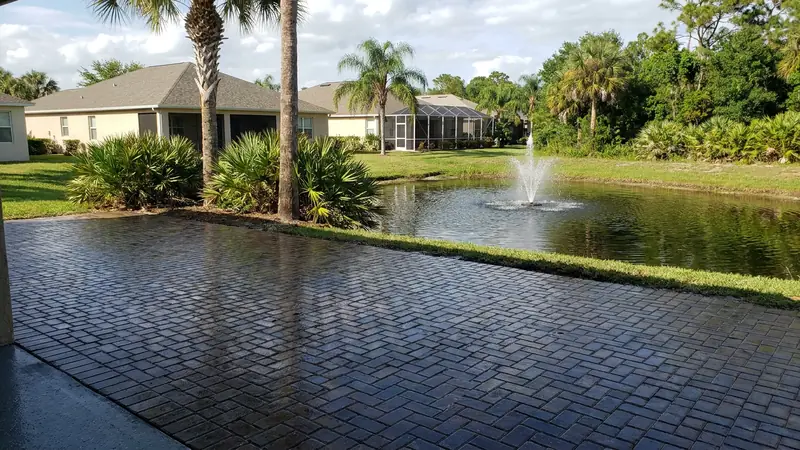
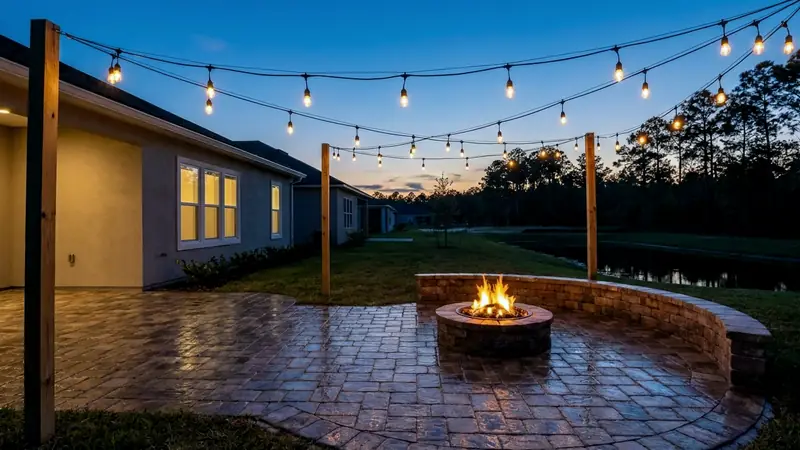
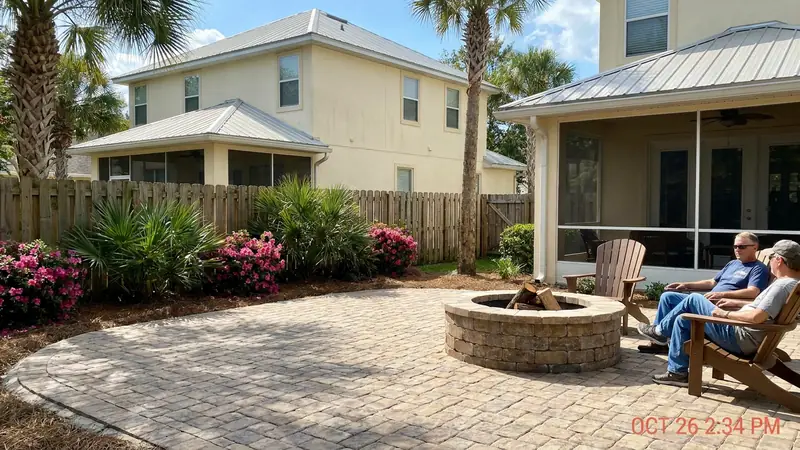
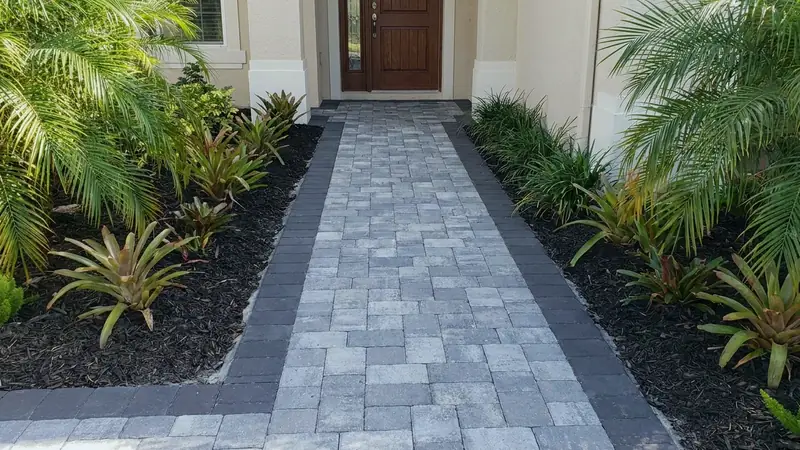
What do sealed pavers look like around Jacksonville Beach?
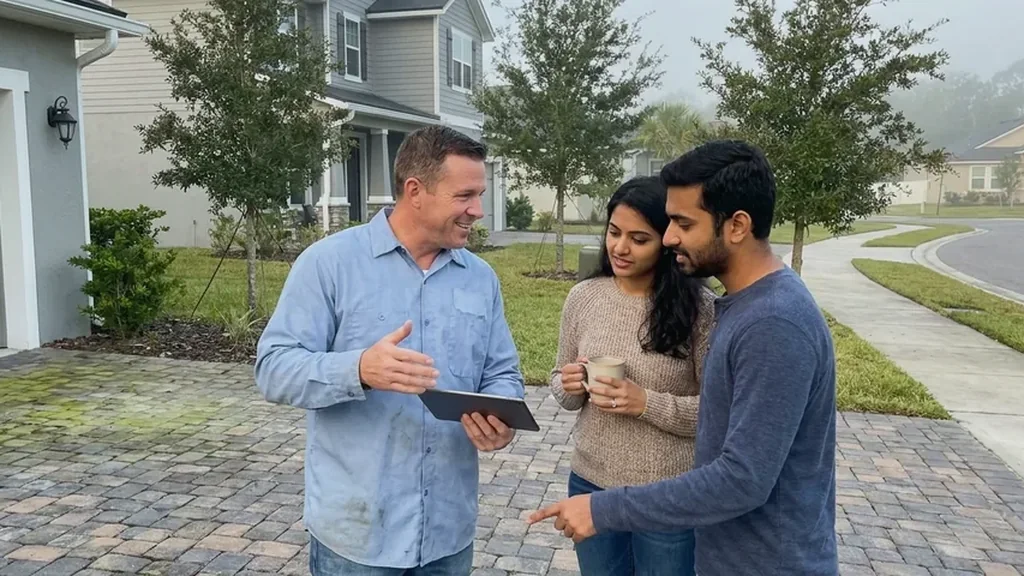
Why local matters in Jacksonville Beach
Why does salt film change the quote?
A contractor who works on the beach knows the difference between a salt film and plain dirt, and that the two come off differently. That shapes how long the wash takes and what the quote says. You can book your free estimate and ask how the contractor would handle your block. That also shapes which sealer fits the surface.
What does living on the island teach a contractor?
Local also means knowing the island. Jacksonville Beach sits on San Pablo Island, with the Atlantic to the east and the Intracoastal Waterway to the west, so wind and moisture reach nearly every yard. A contractor who lives with that plans around it, and a call to (904) 966-4279 will tell you how. Jacksonville Beach kept its own city government when Duval County consolidated with Jacksonville in 1968.
Do city rules touch a paver driveway?
The city also keeps its own rules for paver driveways and the public right-of-way, and updated its paver driveway standards in October 2023. A local contractor can point you to them. When your apron looks tired, book your free estimate and ask what applies. Rules differ between the city, an association and your own lot, and a local contractor can tell you which question to ask first.
What is Jacksonville Beach known for?
What is Jacksonville Beach known for?
Jacksonville Beach is a coastal city of 23,830 people on the northern half of San Pablo Island. The Jacksonville Beach Pier reopened July 6, 2022, after a three-year rebuild, and the 1925 Casa Marina Hotel is on the National Register. Call (904) 966-4279 if you live near either one. Beach Boulevard ends at State Road A1A three blocks from the ocean.
What else is worth a visit nearby?
The Beaches Museum at 381 Beach Boulevard has a history park with the area's first post office, a 1911 train engine and a chapel from 1886. Beach Boulevard itself follows the old rail bed that first brought visitors from Jacksonville. Homes around it have their own driveways and patios to keep up, and you can book your free estimate for a free look. Latham Plaza and Seawalk Pavilion on 1st Street North is a public space with an amphitheater.
Frequently Asked Questions
Is it good to seal pavers in Jacksonville Beach?
Yes, because salt air, sun and sea breeze showers all wear on coastal pavers. Sealer keeps salt residue and oil from soaking in and holds joint sand in place. Sealing does not hide sunken pavers, so those are repaired first. A free estimate shows what your own driveway needs. Left unsealed, concrete pavers fade noticeably within three to five years, one Jacksonville guide says. Ask whether a quote covers washing, sand and sealer together so you can compare it fairly.
How long do paver sealers last at the beach?
Quotes from companies here commonly run two to five years between coats. One Jacksonville company says sunny driveways and pool decks land nearer 18 to 24 months, while shaded walkways go 24 to 36 months. When water soaks in and darkens a paver instead of beading, the coat is spent. Wet look shows scuffs sooner than matte, so a busy driveway may need a recoat sooner. Pool decks with chlorine or salt systems sit at the shorter end.
What is the average cost to seal pavers in Jacksonville Beach?
Prices published around Northeast Florida for a clean, sand and seal run $1.75 to $3.25 per square foot, depending on the job. If an old coat has failed, a strip and reseal runs higher. Your final number depends on size, prep and finish, and the estimate is free. Larger jobs cost less per foot, since prep time does not grow with the area.
Is it better to spray or roll paver sealer?
Many Jacksonville contractors do both. They spray the sealer first for even coverage, then back-roll it to work it into the joints. That method helps avoid puddles that can turn milky. Ask the contractor how the coat will go on at your Jacksonville Beach home. Thin, even coats matter more than heavy ones.
Do I need a permit to seal pavers at my Jacksonville Beach home?
That depends on where the pavers sit. The city says most use of public right-of-way beside a home needs a revocable encroachment permit, so check before work on an apron by the street. For pavers inside your own lot, ask the city or your association. If you are not sure where your property line sits, the city can tell you.
Can condo and townhome patios in Jacksonville Beach be sealed?
Yes, but the association often decides. A Jacksonville paver page says shared patios, courtyards and walkways are usually managed by the association. Ask your board before you book. Small patios can also meet a contractor's minimum job size. One page says a natural-look coat may count as maintenance, while a high-gloss finish is more likely to need approval. Ask whether the association also controls paver color before choosing a sealer.
What time of year is right to seal pavers in Jacksonville Beach?
Late autumn through spring is the dry stretch, with November the driest month at about 2.50 inches. Summer brings heavy rain, with August near 7.54 inches. Sealer needs a dry surface, so dry weeks matter more than the calendar. Hurricane season runs June 1 to November 30 and peaks on September 10, so the stormy months sit in summer and early fall. The peak of hurricane season is September 10, so late autumn is a calmer stretch.
How soon does someone reply to an estimate request?
The contractor gets back to you within 1 business day, usually much sooner. The estimate is free, with no obligation, so you can compare it with other quotes. A written request and a phone call both work.
Ready for a Free Estimate in Jacksonville Beach?
Call (904) 966-4279 and tell us about your pavers.
Free, no obligation